
In this article

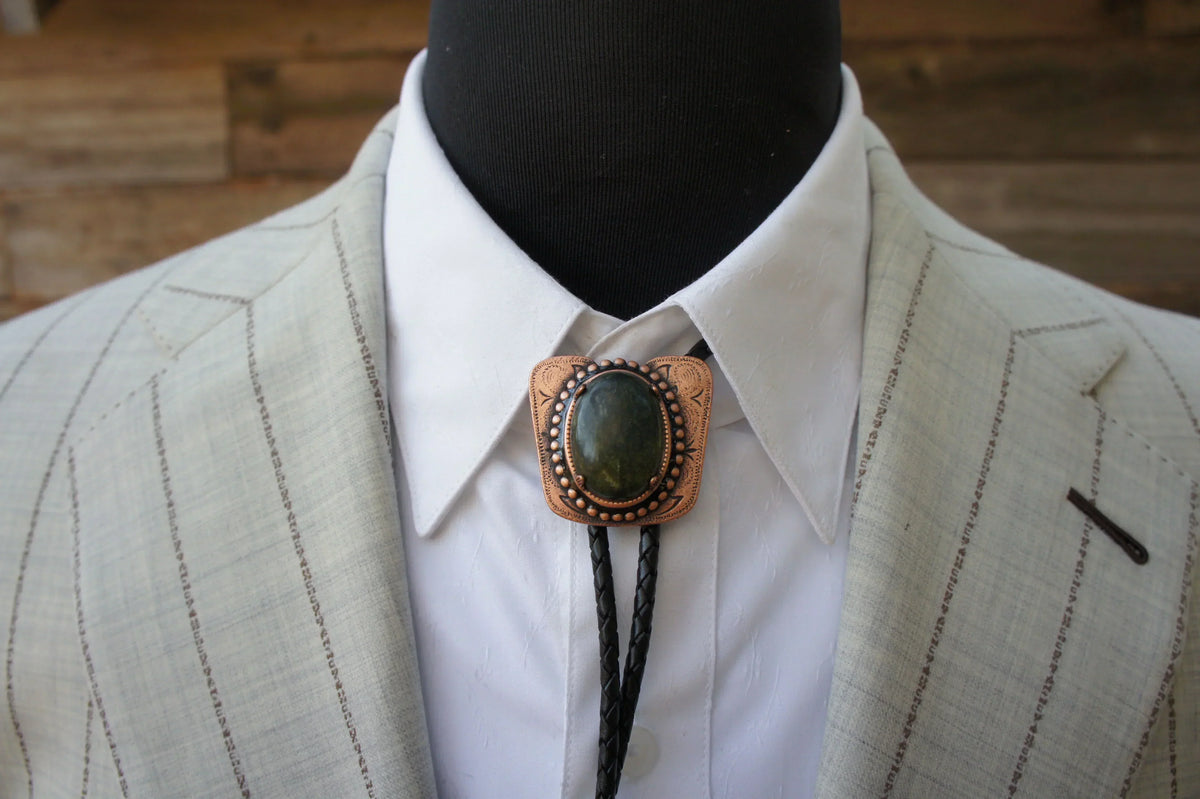
A bolo tie is a cord worn round the collar in place of a necktie, held by a decorative slide, with metal tips on the ends of the cord. That's the whole object. What makes it worth a guide is that the same tie can look formal or relaxed depending on where you set the slide, and most people who buy one for the first time set it wrong.
This guide covers what the parts are called, how to wear one tight or loose, what to pair it with, and how to look after it. There's a short history further down. If it's the history you're after, we're writing a separate piece on that.
What is a bolo tie?

A necktie without the knot. A cord goes round the collar, a slide holds the two strands together at the front, and the cord ends are capped so they hang straight. It came out of the American Southwest and it's still the only neckwear that works equally well done up to the collar or hanging loose over a T-shirt.
The three parts
- The cord. Usually braided leather, sometimes flat leather lace or cotton. It sits round the neck like a necklace. On our bolo ties the cord is leather and comes in one standard length; the slide does the adjusting, so one length fits nearly everyone.
- The slide. The decorative piece at the front. On the back is a clip that grips both strands of the cord so the slide stays where you put it. Push the slide up and the tie sits at the collar. Pull it down and the cord opens out.
- The tips. The metal caps on the two cord ends. They stop the leather fraying and give the ends enough weight to hang straight rather than curl.
The slide is where the money and the personality go. Ours range from plain silver and gold-plated shapes to turquoise, scorpions, horse heads and a dollar coin. The cord and tips are the same across most of them.
How to wear a bolo tie

Because the cord is one fixed length, the way you wear it comes down to where the slide sits. There are really two positions, and everything else is somewhere between them.
Tight, at the collar
Button the shirt to the top. Bring the slide up until it sits in the gap between the collar points, where a tie knot would be. The two strands hang down the shirt front and the tips should finish at about the same height, somewhere around the sternum. This is the formal way to wear it. It works with a suit, a sports jacket, or a plain shirt with the sleeves rolled, and a slim 1¼ inch belt below it rather than a wide one. A smaller slide looks better here than a large one; a big slide at the collar crowds the face.
Loose, on the chest
Leave the top button or two open. Drop the slide down so it sits on the chest, roughly where a pendant would hang. The cord now shows as a loop round the open collar. This is how most people wear one with a T-shirt, a denim shirt, or a shirt worn open over a vest. Bigger, heavier slides suit this position; they have room.
Between those two there's a half position, slide sitting just below an open top button, which is the one most men settle on for everyday wear.
| Tight | Loose | |
|---|---|---|
| Slide sits | Between the collar points | On the chest, pendant height |
| Collar | Buttoned to the top | Top one or two buttons open |
| Slide size | Small to medium | Medium to large |
| Tips finish | Around the sternum | Lower, near the stomach |
| Goes with | Suit, jacket, dress shirt | T-shirt, denim, open shirt |
Putting one on
- Hold the slide and drop the cord over your head so the slide is at the front.
- Push the slide up or down to the position you want, tight or loose.
- Hold the slide still and pull one strand until the two tips hang level.
- Check the collar: buttoned and flat if tight, open and folded if loose.
Getting the tips even
Hold the slide still with one hand and pull one strand gently with the other until the tips line up. Uneven tips are the most common giveaway that someone hasn't worn one before. If the tips keep drifting, the clip on the back of the slide has loosened; squeeze it a little with your fingers and it will grip again.
What to pair it with
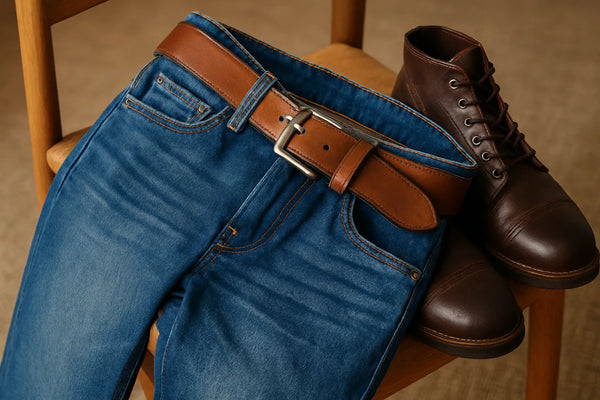
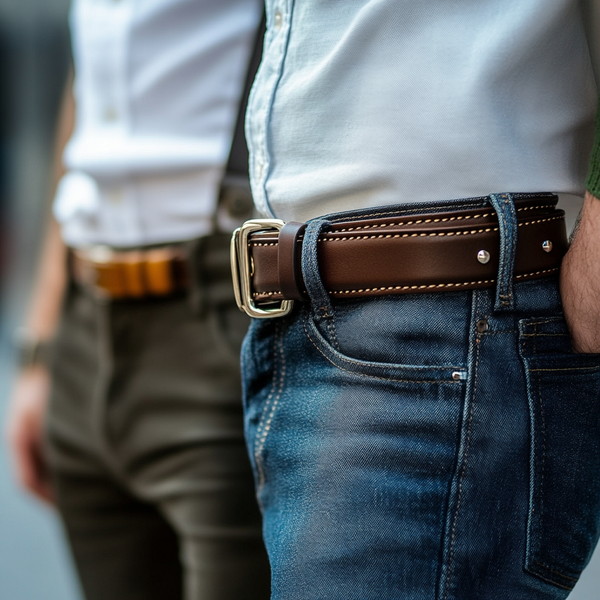
The rule that works: match the metal. A silver slide with a silver belt buckle, a gold-plated slide with a brass or gold buckle. Bolo ties are an accessory you notice, and a mismatched buckle a few inches below it is the first thing the eye catches. We make the belts and buckles here in the workshop, so this is the pairing we get asked about most.
Beyond that:
- A plain shirt, any colour, lets the slide do the talking. Patterns fight with it.
- Denim shirts and bolo ties were made for each other. That's the western look, and it still holds up.
- With a suit, keep the slide small and the position tight. Treat it like a tie, not jewellery.
- Women wear them too, usually loose over an open collar or a plain top, and often with a larger slide.
Bolo ties in the shop
Our bolo ties are made for us by a specialist supplier in the western style, with leather cords and metal slides and tips. Six that show the range:


The full range is in the bolo tie collection.
Where the bolo tie comes from

The short version. Silversmiths in the American Southwest, Navajo and Zuni among them, were making silver and turquoise neck ornaments on cords well before anyone called them bolo ties. The name and the modern form are usually credited to Victor Cedarstaff, a silversmith from Wickenburg, Arizona, who in the late 1940s put a silver hatband round his neck to stop it blowing away and liked the look. He patented a slide design in 1959 and named the tie after the boleadora, the weighted cord Argentine cowboys throw to catch cattle.
Arizona made it the state's official neckwear in 1971. New Mexico followed in 1987 and Texas in 2007. Westerns on television in the fifties and sixties put it on cowboys, and that's the association most people still have. In Britain it's often called a bootlace tie, and it had a run with the Teddy boys in the same decade.
Fashion houses pick it up every few years. Ralph Lauren has used it as part of a western wardrobe for decades. Gucci and Saint Laurent have both sent it down a runway. None of that changes how you wear one.

Styles of slide you'll see

- Turquoise and silver. The Southwestern original. Real Native-made pieces are signed and priced accordingly; most of what's sold under the name is cast metal with a set stone, ours included.
- Figurative. Animals, skulls, coins, tools. The slide tells you something about the wearer. Best worn loose.
- Plain metal. A simple oval or bar. The one to buy if you want to wear it to work with a collar and not have anyone comment.
- Vintage and repurposed. Brooches, car badges and belt buckle centres made into slides. Two of the readers who left comments below make their own this way.

Making your own

It's a common first leatherwork project and the comments on this post prove it. You need a length of round braided leather cord, about 36 to 40 inches, two metal tips, and something to be the slide; a cut-down western buckle works well. Bolo clips, the spring-backed findings that grip the cord, are sold on their own; glue or solder one to the back of a brooch, a badge or a cut-down buckle. Thread the cord through, glue the tips on the ends, leave it overnight. If the slide slips, the clip needs a firmer spring or a dab of glue on the cord where it sits.
Looking after one

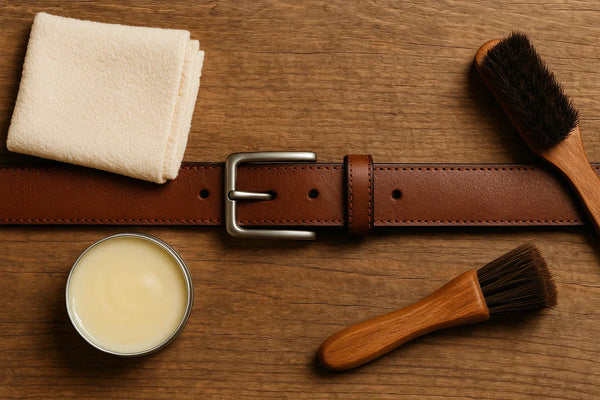
Wipe the slide with a soft dry cloth after wearing. Sterling silver takes a silver cloth; plated pieces don't, and polish will take the plating off, so leave those alone beyond a wipe. Keep the leather cord dry. If it gets wet, let it dry at room temperature and rub in a very small amount of leather conditioner, the same you'd use on a belt; our belt care guide covers how much and how often. Store it flat or hanging with the cord loosely coiled, not knotted. A tangled cord kinks, and kinks in braided leather don't come out.
Old ones: a cracked or frayed cord can be replaced for a few pounds and the original slide moved across. Don't throw a good slide away for a bad cord.
Common questions

Can you wear a bolo tie with a suit?
Yes. Button the collar, set the slide tight, keep the slide small. It's accepted business wear across the American Southwest and it reads as a deliberate choice anywhere else.
Is a bolo tie formal or casual?
Both, and the slide position decides which. Tight at the collar is formal. Loose on the chest is casual.
How long should a bolo tie be?
Most are 36 to 40 inches of cord, and that suits almost everyone because the slide sets the fit. Very tall men may find the tips finish higher than they'd like when worn tight; wearing it a touch looser fixes that.
Which way up does the slide go?
Clip at the back, decoration facing out, and the clip's open side facing down so the cord feeds through from the bottom. If the slide keeps sliding down on its own, it's in upside down or the clip has loosened.
Can women wear bolo ties?
They always have. Worn loose over an open collar or a plain top, usually with a larger slide.
What's the difference between a bolo tie and a bootlace tie?
Nothing. Bootlace tie is the British name, from the Teddy boy era. Bola tie is an older American spelling.
Do you make your bolo ties?
No. We make leather belts and straps here. The bolo ties are made for us by a supplier, chosen to pair with the buckles we sell. Matching metals between slide and buckle is the reason we carry them.

Recommended next steps
- Shop bolo tiesLeather cord bolo ties to pair with our buckles.
- Shop men’s beltsFull-grain leather, cut to your measurement.
- Contact the workshopAsk us about sizing, leather or a custom order.
2 comments
Matthew smith
I found this information very helpful as I am contemplating setting up my own business and retirement making bolo ties so thank you very much. It was very helpful.
Ricky Miller
I am glad to see bolo ties in current fashion trends. I have collected and worn them for over a decade, when no one else did. I have also made several, from chrome classic car emblems and old brooches. Quite by accident, I have come by the materials to make one or two hundred.